Practice remembering.
Observe, try to remember, then review. Research on retrieval practice informs our approach to making memory practice engaging.
 lucid harborLABS
A BOUTIQUE STUDIO FOR THE CURIOUS MIND
We create games and digital experiences that make memory and cognitive practice feel inviting, engaging, and human.
Explore our work
01 / WHY WE EXIST
A familiar scene. A detail you almost missed. The pleasure of remembering. We believe these small moments can make practicing with your mind a welcome part of the day.
We exist to make memory and cognitive practice approachable through thoughtful play, clear design, and respect for each person’s pace.
02 / WHAT WE’RE MAKING
Our first exploration: memory.IN DEVELOPMENT
A small moment of play.
A chance to notice more.
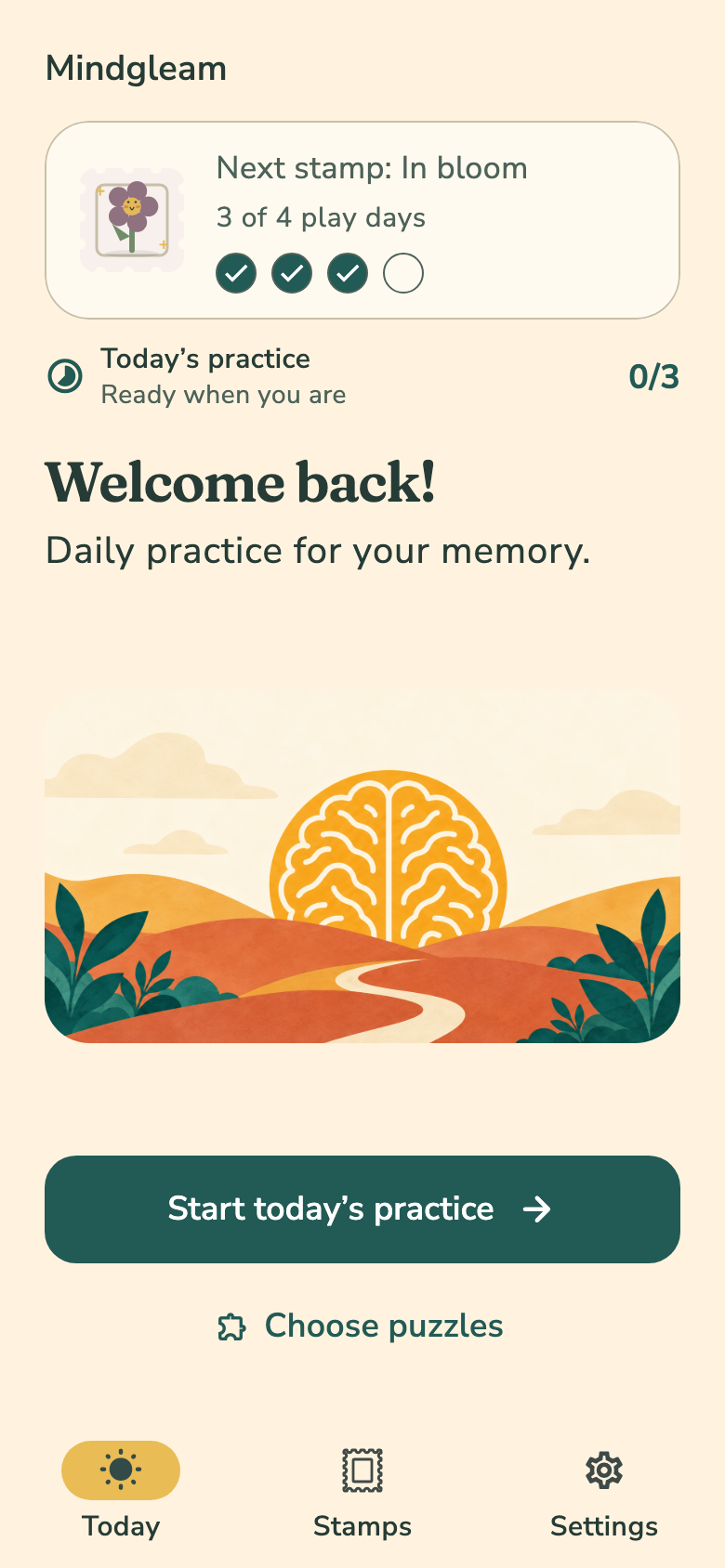
A memory-practice game with familiar scenes, colorful details, and time to take it all in. Observe, remember, and discover what caught your eye.
The current preview includes six puzzle types, self-paced observation, adjustable text, optional sound, and a collection of illustrated stamps. Progress stays on the device.
Mindgleam is still in development and is not available in the App Store. It’s a game for enjoyment and memory practice; game results don’t establish changes in everyday memory.
03 / HOW WE THINK
Observe, try to remember, then review. Research on retrieval practice informs our approach to making memory practice engaging.
A result should be understandable. Mindgleam lets you review the original scene after a round, at your own pace.
Pair research-informed design with accessible, self-paced play. Be clear about the difference between game performance and everyday memory.
Research informs the design. Mindgleam’s own benefits still need to be tested.
Trying to remember. Experiments have found that retrieving studied information can improve later retention compared with restudying it. Those findings concern the material people learned. Mindgleam uses visual scenes and cued choices; these studies did not test our game. Roediger & Karpicke, 2006 ↗
Checking the answer. In a study of multiple-choice learning, corrective feedback improved later recall and reduced errors carried over from misleading options. Mindgleam offers an original-scene review after each round. Butler & Roediger, 2008 ↗
Returning after a delay. Spacing reviews of the same information can support its retention, with useful intervals depending on how long it needs to be remembered. Mindgleam’s working preview now brings familiar scenes back after a delay, with an optional another look and no catch-up pressure. Its review timing is a design choice to test, not a validated schedule. Cepeda et al., 2008 ↗
Keeping the conclusions specific. A 2025 review of reviews found support for cognitive training in healthy older adults, while noting that most included reviews were of low or critically low quality. An earlier comprehensive review found stronger support for gains on trained tasks than for everyday cognitive benefits. Neither validates Mindgleam. Velloso et al., 2025 ↗ · Simons et al., 2016 ↗
We describe Mindgleam as research-informed memory practice. We do not claim that it improves everyday memory, treats a condition, or prevents cognitive decline. Our accessibility choices are design commitments, not proven cognitive benefits. Research notes reviewed October 18, 2026.